Why Two Paver Quotes for the Same Yard Differ by $10,000 (Line by Line)
Bay Area homeowners regularly get paver quotes from $8 to $30+ per square foot for the same project. The gap is almost never profit. It is base depth, compaction, tear-out, haul-off, access and drainage. Here is how to line up two bids and see what each one actually includes.
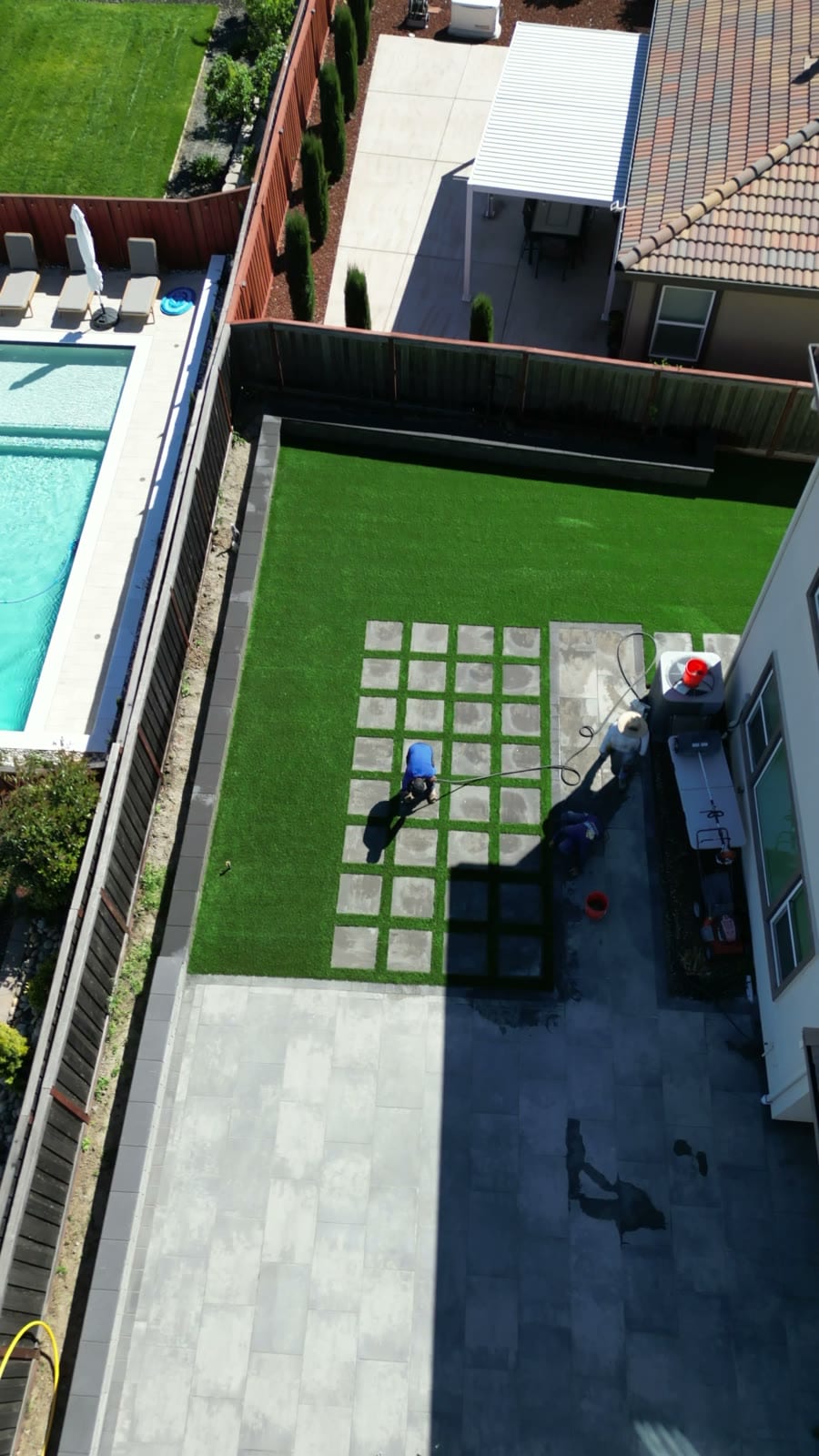
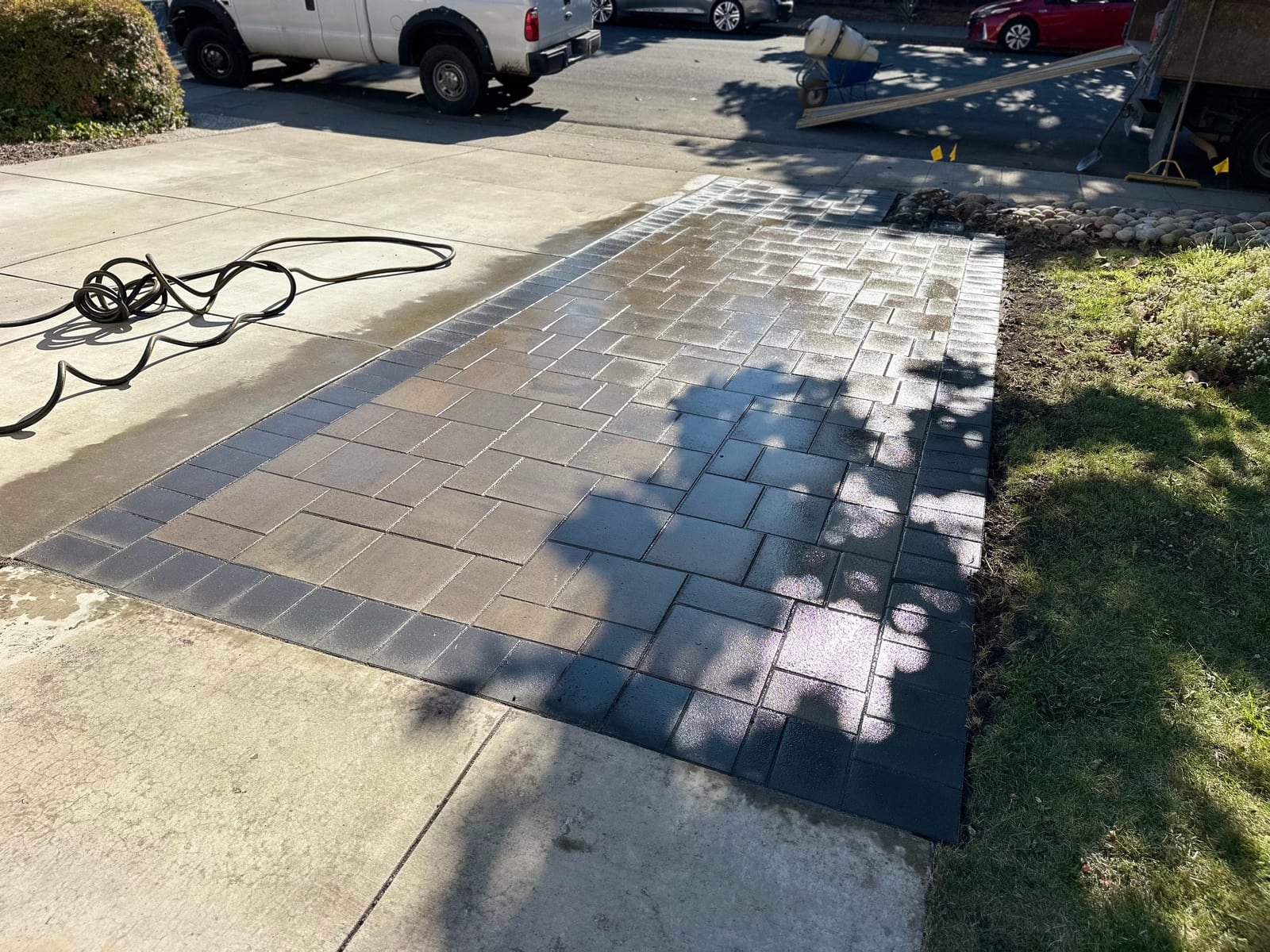
Fairfield, CA. Two contractors can quote this yard $10,000 apart. The difference is almost all under the surface.
A South Bay homeowner posted their driveway quotes on an online forum. One came in around $6 per square foot. Another was over $30. Same driveway, several companies that all looked legitimate.
They were not all quoting the same job. That is the whole story, and it is the most common problem we see when people call us with "I have two other bids."
Here is how to put quotes side by side and figure out which one is real.
What should a complete paver quote cost in the Bay Area?
For a complete installed paver patio in 2026, $28 to $45 per square foot. Walkways $30 to $50, because they are narrow and almost all edge. Driveways $15,000 to $23,000 for a typical 450 to 600 square foot driveway. Our Bay Area patio cost guide and driveway cost guide break those down.
"Complete" means: remove what is there, dig out the soil, haul it away, build and compact the base, lay the pavers, cut the edges, install the border and edge restraint, fill the joints, compact, clean up.
When a quote is far below that range, one of those steps is missing, shrunk or done by someone who does not carry a license, workers' comp or liability insurance.
Where does the money go on a paver job?
On a typical 400 square foot backyard patio, roughly:
| Line | Share of price | What it pays for |
|---|---|---|
| Demolition and haul-off | 10 to 20% | Breaking out old concrete or lawn, dump fees by weight |
| Excavation | 5 to 10% | Digging 8 to 10 inches of clay, trucking it out |
| Base and bedding | 15 to 20% | Class II road base, bedding sand, compaction in lifts |
| Pavers and border | 20 to 25% | Material, the soldier course, cuts |
| Laying, cutting, finishing | 25 to 30% | The visible part |
| Drainage, edge restraint, joint sand | 5 to 10% | Slope, drains, polymeric sand |
More than half of the money goes into steps you will never see again after the third day. That is exactly why that half is where low bids find their savings.
How do you compare two quotes line by line?
Ask every contractor to answer the same questions in writing. Then put the answers in columns. Here is what we would ask, and what a good answer sounds like.
1. How deep is the excavation, and how deep is the compacted base? On Bay Area clay, a patio needs 8 to 10 inches of excavation and 6 inches or more of compacted base. A driveway needs more. "We use a 4-inch base" on clay soil is the single biggest red flag in a paver quote.
2. Do you compact in lifts? The base should go in a couple of inches at a time, each layer compacted with a plate compactor before the next. Dumping 6 inches and running the compactor over the top once looks the same on day three. It does not look the same in year three.
3. What gets removed, and who pays the dump? Old concrete is heavy and dump fees go by weight. Breaking out a slab usually adds $3 to $6 per square foot. Some quotes assume you already did it.
4. How many truckloads of soil leave the site? If the excavation is real, the soil has to go somewhere. A quote with no haul-off line is either leaving the dirt on your lot or not digging deep enough.
5. Which paver, which line, how thick? Brand and product name. 60mm is standard for patios. 80mm is better for driveways. A quote that just says "pavers" leaves the cheapest option open.
6. How does water leave the patio? The surface should slope away from the house about a quarter inch per foot. If there is no place for water to go, the quote should include a channel drain, a dry well or a French drain. Read base prep and drainage before the rains for why this matters on clay.
7. What holds the edges? A concrete or plastic edge restraint, spiked or set in concrete, under the border. Without it, the edges creep and the joints open.
8. What goes in the joints? Polymeric sand is standard. Plain sand washes out. If you are applying for a lawn conversion rebate, the joint material can matter, because some water districts disqualify polymeric sand.
9. Who does the work? Their own crew or a subcontractor. Both can be fine. You should know which.
10. Is the license active, and does it match the work? Look it up on the CSLB website. Paver and landscape contractors usually carry a C-27 license. Check that workers' comp is on file.
Why does access change the price so much?
Because labor is most of the price, and access decides how fast the labor goes.
A Sunnyvale backyard with an 8-foot side yard lets a compact track loader carry soil out and base rock in. A San Francisco row house where everything goes through the garage, down a hallway or up a flight of stairs means wheelbarrows, sometimes a conveyor, sometimes a street permit for a dumpster. Same patio, 10 to 25 percent more labor, sometimes more.
A good quote names the access plan. If one bid assumes a machine and the other assumes wheelbarrows, the gap is explained.
What else can make one bid higher than another?
- Slope. A sloped lot means more digging, sometimes a step or a low wall, sometimes a grading permit. See do I need a permit for a paver patio.
- Shape. Curves and inlays are cuts. A curved patio can cost 10 to 20 percent more than a rectangle of the same size.
- The border. A double soldier course in a contrasting color takes time.
- Permits and engineering. A retaining wall over the threshold needs both. One bid may include them. The other may "forget."
- Schedule. Some crews price lower in slow months. That is a fair discount. A discount on base depth is not.
How much deposit is legal in California?
For home improvement contracts, California law caps the down payment at 10 percent of the contract price or $1,000, whichever is less. After that, payments should match work completed. The CSLB's consumer guide to home improvement contracts lays it out.
If someone asks for 30 or 50 percent "for materials," that is a warning sign. The cases where paver crews take a deposit and disappear almost all start there.
What should the contract say?
A contract you can enforce has, at minimum:
- Contractor name, address and license number
- The area in square feet and a sketch or plan
- Paver brand, product line, color and thickness
- Excavation depth, base depth, base material, compaction method
- What gets removed and hauled away
- Slope, drains and where the water goes
- Edge restraint and joint material
- Start date, expected duration and a rain delay clause, because Bay Area winter rain can stop base work for days
- Payment schedule tied to completed work, with the deposit inside the legal limit
- Warranty terms for both the product and the workmanship, in writing
- Who pulls permits, if any are needed
If a contractor pushes back on putting the base depth in writing, you have your answer about that contractor.
Is the cheapest quote ever the right one?
Sometimes. If two bids list the same base depth, the same paver, the same removal, the same drainage and the same license and insurance, take the lower one. That happens.
What we would not do is pick a bid that is cheaper because the base is thinner. Cut square footage instead. A smaller patio built right lasts. A bigger one built on 3 inches of base over clay starts moving in the first wet winter, and fixing it means pulling the pavers and starting over.
How do we write our quotes at Royal?
Every Royal quote lists the excavation depth, the base depth, the paver line and thickness, what we remove and haul, how the water drains, the edge restraint and the joint material. We build on our Permalast Layered Install System, base placed and compacted in layers, with pavers rated up to 8,000 PSI. Our own crews do the work. We are licensed, bonded and insured, and we have been building across the Bay Area for more than 15 years.
If you already have a quote, have it on hand at the consultation and we will go through it line by line next to ours. Call 1-888-282-1344 or request a free design consultation. More on how we pick crews and why it matters in how to choose a paver contractor in the Bay Area.
Frequently asked questions
Why are paver quotes so different?+
Because most of the cost is invisible once the job is done. Base depth, compaction in layers, removal of the old surface, how many truckloads of soil get hauled away, access for equipment, drainage and the border all vary between bids. A low quote usually leaves one or more of those out or shrinks them. Ask every contractor to write the same items down so you can compare.
What is a fair price per square foot for pavers in the Bay Area?+
For a complete installed paver patio in 2026 we see $28 to $45 per square foot in the Bay Area, and $30 to $50 for walkways. Quotes in the single digits per square foot usually mean labor only, no tear-out, a thin base, or a crew that is not licensed and insured.
How much of a deposit can a contractor ask for in California?+
For home improvement work, California law limits the down payment to 10 percent of the contract price or $1,000, whichever is less. After that, payments should follow work actually completed. A contractor asking for half up front is breaking the rule.
How deep should the base be under pavers?+
On Bay Area clay, we excavate 8 to 10 inches for a patio and install 6 inches or more of compacted Class II base plus about an inch of bedding sand. Driveways go deeper, usually 8 to 12 inches of base. A quote that says 3 or 4 inches of base on clay is a red flag.
What should a paver contract include?+
The contractor's license number, the exact area, the paver brand, line and thickness, the base depth and compaction method, what gets removed and hauled away, how water drains and where, the edge restraint, the joint sand, the schedule, a rain delay clause, the payment schedule tied to work completed, and the warranty terms in writing.
Paver Patios
Outdoor living rooms built to host every season.
Written by João at Royal Outdoor Solutions
Family-owned Bay Area hardscape contractor with 15+ years of hands-on experience installing paver patios, driveways, walkways, pool decks and retaining walls. Licensed, bonded and insured.
1-888-282-1344
Tell us about your project.
Free, no-obligation estimate. We come measure on-site, walk you through the design options, and follow up in writing.