What a Paver Driveway Costs in the Bay Area (2026), and Where the Money Actually Goes
Most Bay Area paver driveways land between $15,000 and $23,000, against $9,000 to $12,000 for concrete. The gap is almost entirely base depth and edge work, and here is how to read a quote line by line.
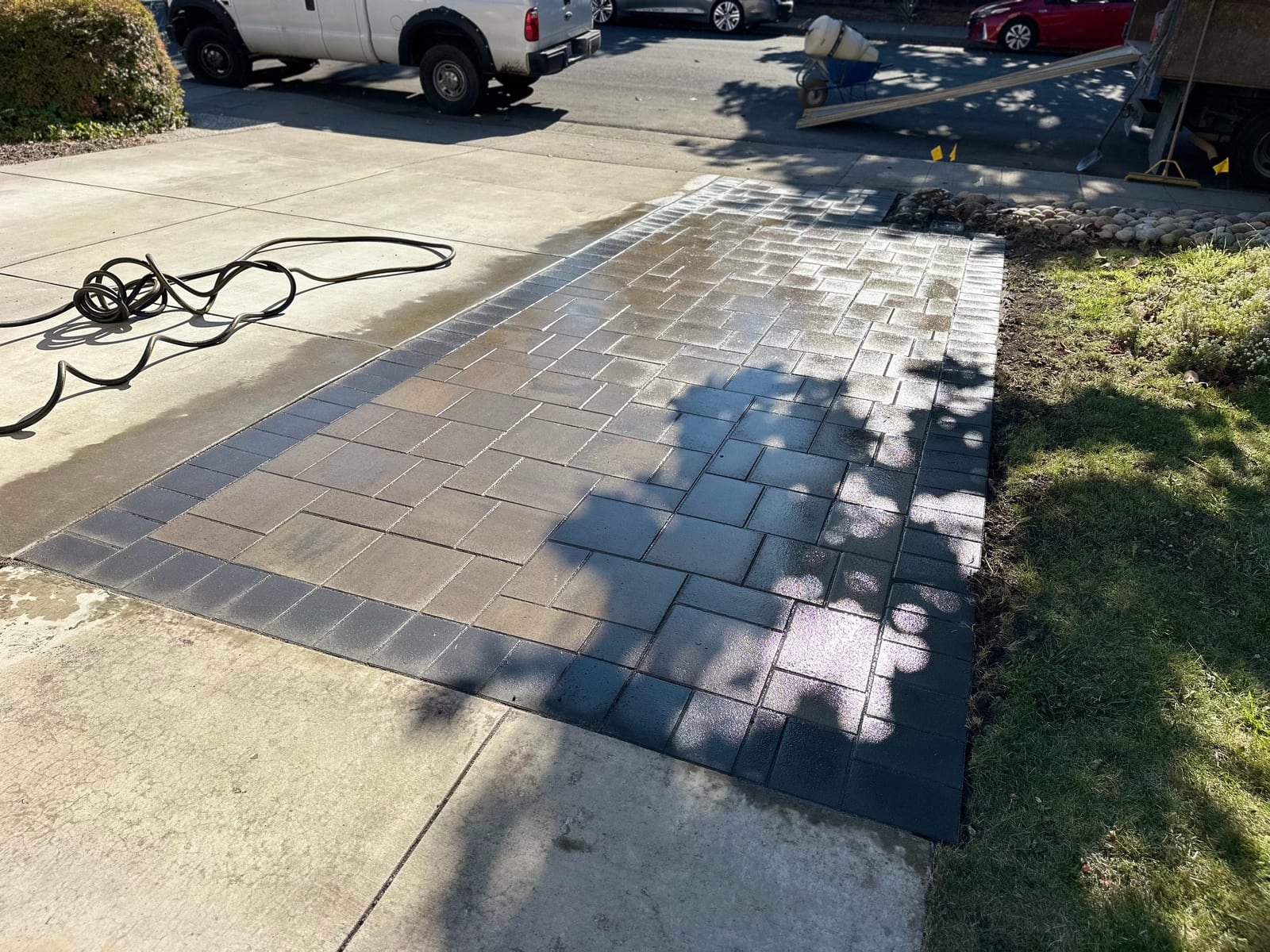
A driveway carries thousands of pounds twice a day. Everything in the price is about what is under it.
The number people expect is the number for the pavers. That is never the number.
A pallet of quality concrete pavers is a real cost, but on a Bay Area driveway it is rarely more than a quarter of the invoice. The rest is dirt, gravel, compaction and hands.
The range, and what sits at each end
Most residential paver driveways we install in the Bay Area land between $15,000 and $23,000. Concrete for the same footprint usually quotes at $9,000 to $12,000.
The low end of the paver range is a flat, straightforward driveway on soil that drains, with nothing to demolish. The high end is a long driveway, or a sloped approach, or one where 40 tons of old concrete has to come out and go somewhere before the first shovel of base goes in.
We have done driveways well below that band and well above it. The band is where most of them sit.
Where the money actually goes
Demo and haul-off. Breaking out an existing concrete driveway and trucking the debris off is frequently the single biggest line item nobody anticipated. It can be several thousand dollars before any new material arrives.
Excavation. A driveway base goes deeper than a patio base because it carries vehicle loads. Deeper base means more dirt out and more gravel in, and both are priced by the ton.
Base and compaction. This is the part that decides whether you are still happy in ten years. Compacted in lifts, not dumped and rolled once.
Edge restraint. A paver field with no edge spreads. On a driveway, where wheels track the same line every day, the edge is under constant load. Skipping or cheapening it is the most common failure we get called to repair.
Cutting. Curves, aprons and the transition at the garage cost hours on a saw. A rectangular driveway is cheaper than a curved one, and the difference is real.
Why the thickness matters here more than anywhere else
Driveway pavers are not patio pavers. Ours are 8,000 PSI, roughly twice the compressive strength of standard poured concrete, and on driveways we use a thickness rated for vehicle traffic.
If a bid does not state the paver thickness, ask. A patio-thickness paver under a truck will crack, and no warranty on earth covers the wrong product installed in the wrong place.
The comparison nobody runs properly
Concrete is cheaper on day one. Here is the part that changes the math:
Bay Area clay expands and contracts with the wet and dry seasons. A concrete slab is one rigid piece, so when the ground moves, it cracks. That is not bad workmanship, it is what slabs do here. Repairing a cracked slab means cutting out a section and pouring a patch that will never match.
A paver driveway is thousands of small pieces on a flexible base. The ground moves and the field moves with it. If a section ever settles, we lift those pavers, correct the base and set the same pavers back. No patch, no color mismatch.
You can find our longer comparison of the two in Paver Driveway vs. Concrete in the Bay Area.
Three questions to ask about any driveway quote
How deep is the base and is it compacted in lifts?
What paver thickness, and is it rated for vehicle traffic?
Is demo and haul-off included, or is it an allowance that can grow?
That last one catches more surprises than the other two combined.
Getting your actual number
Ranges are useful for deciding whether to keep reading. They are useless for deciding whether to build.
We measure on site, look at your grade and your soil, tell you what has to come out, and hand you an itemized estimate. Free, no deposit, and the number holds. Call 1-888-282-1344 or book a free on-site design consultation and we will get you a real figure, usually within a day of the visit.
Frequently asked questions
How much does a paver driveway cost in the Bay Area?+
Most residential paver driveways we install run $15,000 to $23,000. A short flat driveway on good soil can come in under that. A long driveway, a steep approach, or one that needs the old concrete broken out and hauled away pushes above it. The honest answer needs a measurement and a look at your grade.
Why are pavers more expensive than concrete?+
The pavers themselves are only part of it. A paver driveway needs a deeper compacted base than a concrete slab, an edge restraint all the way around, and hand-laying and cutting on site. Concrete is poured and finished in a day. That labor difference is most of the gap between $9,000 to $12,000 for concrete and $15,000 to $23,000 for pavers.
Can pavers be laid over my existing concrete driveway?+
Sometimes, if the slab is sound, the drainage still works, and the extra height does not create a step at the garage door or the street. More often the slab is already cracked, which means it is moving, and laying pavers over something that moves just transfers the problem upward. We tell you which one you have before quoting it.
How long does a paver driveway take to install?+
A typical residential driveway runs about five to eight working days: demo and haul-off, excavation, base in compacted lifts, bedding sand, laying and cutting, edge restraint, joint sand and a final compaction. Weather during the rainy season can stretch it, which is why we schedule driveway work into the dry months when we can.
Driveways
Engineered for cars, trucks, RVs and boats.

Written by João at Royal Outdoor Solutions
Family-owned Bay Area hardscape contractor with 15+ years of hands-on experience installing paver patios, driveways, walkways, pool decks and retaining walls. Licensed, bonded and insured.
1-888-282-1344More guides
All guides → Maintenance
How to Maintain a Paver Patio in the Bay Area: Sealing, Weeds, Efflorescence and Winter Prep
 Project Stories
Orinda Front Yard: A Paver Walkway and Artificial Turf That Replaced a Dying Lawn
 Permits & Rules
Zone 0: What California's New 5-Foot Fire Rule Means for Your Patio, Walkways and Fences
Tell us about your project.
Free, no-obligation estimate. We come measure on-site, walk you through the design options, and follow up in writing.