Paver Driveway vs. Concrete in the Bay Area: Which One Actually Lasts on Our Soil?
Concrete is cheaper on day one. On Bay Area clay it cracks, heaves and gets patched. Here is how the two driveways compare on cost, durability, repairs and resale, with real numbers.
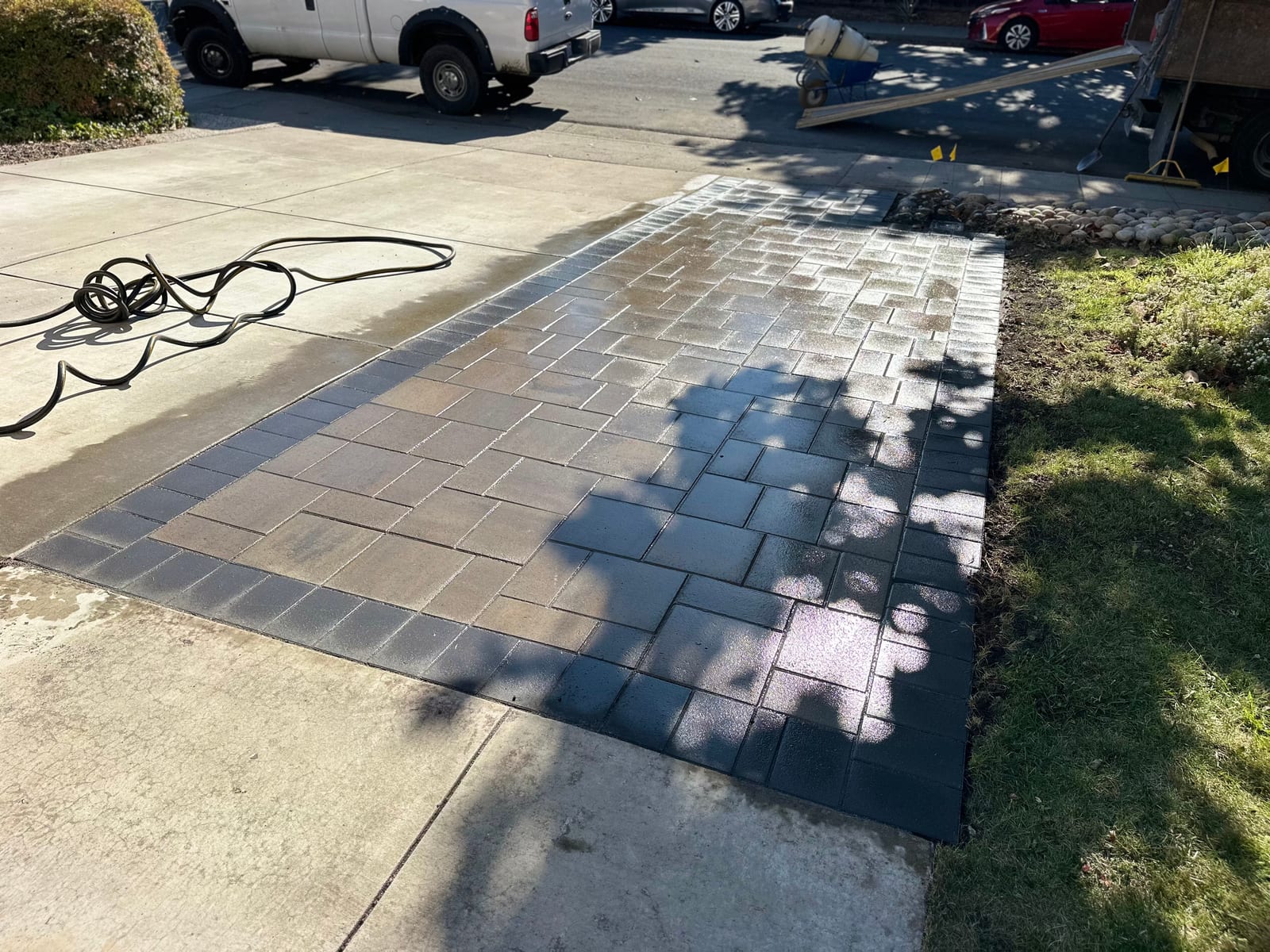
Every week we walk up a driveway in the East Bay that looks like a map: a long crack from the garage to the street, a corner that has sunk an inch, a patch from a previous repair that never matched. Most of them are less than ten years old. The homeowner usually asks the same question: do I pour concrete again, or do I go with pavers?
Here is the honest comparison, with the numbers we actually see on Bay Area jobs.
Day-one cost
| Driveway type | Installed cost (Bay Area, 2026) | Typical lifespan on clay soil |
|---|---|---|
| Basic poured concrete | $12 – $20 / sq ft | 8 – 15 years before major cracking |
| Stamped or colored concrete | $18 – $28 / sq ft | Same as above, harder to patch |
| Paver driveway, standard pavers | $25 – $38 / sq ft | 30+ years with basic maintenance |
| Paver driveway, premium or permeable | $32 – $48 / sq ft | 30+ years |
So yes, concrete wins the first check. A 600-square-foot driveway might run $9,000 to $12,000 in concrete against $15,000 to $23,000 in pavers. The question is what each one costs you over the time you own the house.
Why concrete fails here specifically
The Bay Area is a hard place for a rigid slab.
Expansive clay. Much of the East Bay, Contra Costa and the Tri-Valley sits on clay that absorbs winter rain and swells, then dries and shrinks through summer. The ground under your driveway moves every year. A single poured slab has no way to absorb that.
Seismic movement. Even small tremors shift soil. Concrete gets hairline cracks that turn into real cracks as water gets in.
Tree roots. Mature trees in Alameda, Berkeley and Marin lift slabs from underneath.
Water. Once a crack opens, water gets under the slab, washes out the base, and the slab settles unevenly. That is the sunken corner you see everywhere.
Pavers handle all four differently. Each paver is a separate unit sitting on a compacted, flexible base. When the ground moves, the surface moves with it in tiny increments instead of snapping. When a tree root lifts a section, we pull those pavers, fix the base, and reset them. Nobody can tell where the repair was.
Repairs: the part nobody prices in
This is where the 20-year math flips.
- Concrete repair means cutting out a section and pouring new. The new pour never matches the old color. Cracks that are "filled" reopen. A badly failed slab gets jackhammered out and replaced, which means paying for the whole driveway again.
- Paver repair means lifting the affected pavers, fixing what is underneath, and setting the same pavers back. Cost is usually a few hundred dollars. If a paver is stained by oil or damaged, one piece gets swapped.
Add utility work to that list. If a water line or sewer lateral under the driveway ever needs access, a paver driveway is opened and closed. A concrete driveway is destroyed.
Strength for cars, trucks, RVs and boats
A common worry is whether pavers can take the weight. The pavers we install are rated to 8,000 PSI, roughly twice the compressive strength of standard residential concrete. The base for a driveway is built deeper than for a patio, and compacted in lifts, so full-size trucks, RVs and boat trailers park on it without rutting. Interlocking pavers actually spread a point load across neighboring pavers, which is part of why airport aprons and shipping ports use them.
Curb appeal and resale
A paver driveway is the first thing a buyer, a guest or a delivery driver sees. Borders, patterns and color choices turn a functional surface into part of the home's design. Appraisers and agents in the Bay Area consistently treat a well-built paver driveway as a premium feature. A cracked slab, by contrast, goes straight onto the buyer's negotiation list.
What a proper paver driveway build includes
If you decide on pavers, make sure the quote covers the whole job. A driveway is not a patio with cars on it. It needs:
- Demolition and disposal of the old concrete or asphalt.
- Excavation deeper than a patio, typically 10 to 12 inches.
- Compacted crushed rock base installed in lifts, not dumped and leveled once.
- Drainage so water runs to the street or a drain, not toward the garage.
- Edge restraint along every edge so the pattern cannot spread under wheel loads.
- Bedding sand, pavers, polymeric joint sand and a final compaction pass.
- License, bond, insurance and a written warranty.
We cover what to look for in a quote in more detail in our Bay Area paver patio cost guide. The same seven questions apply.
Our recommendation
If you plan to sell within two or three years and the current driveway is only cosmetically tired, a concrete resurface can make sense. If you plan to stay, or the slab is already cracking and sinking, pavers are the better investment. You pay more once and stop paying for the driveway after that.
Royal Outdoor Solutions installs paver driveways across the East Bay, Contra Costa, Marin, the South Bay, the Tri-Valley and Solano County. Family-owned, 15+ years of experience, licensed, bonded and insured, with the manufacturer's warranty in writing. See the driveway service, look at a finished driveway project, or request your free on-site estimate.
Written by the Royal Outdoor Solutions team
Family-owned Bay Area hardscape contractor with 15+ years of hands-on experience installing paver patios, driveways, walkways, pool decks and retaining walls. Licensed, bonded and insured.
1-888-282-1344More guides
All guides →
Tell us about your project.
Free, no-obligation estimate. We come measure on-site, walk you through the design options, and follow up in writing.