Before the Rains: Why Base Prep and Drainage Decide Whether Your Bay Area Patio Lasts
Every winter, Bay Area homeowners find out which patios were built on a real base. Here is what happens under a paver patio when it rains, what a proper base looks like, and why fall is the time to build.
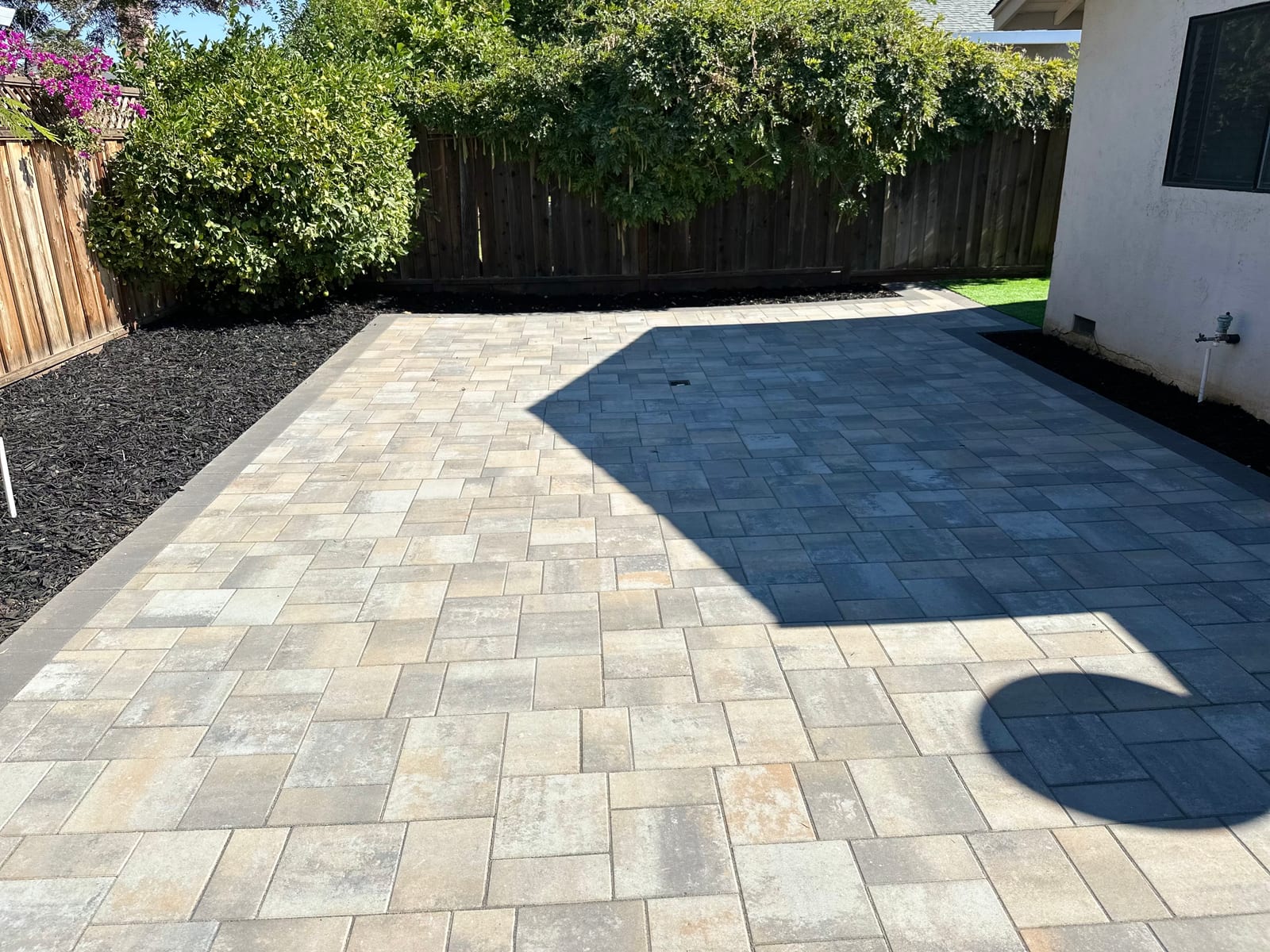
The finished photo of a paver patio shows maybe 10 percent of the work. The other 90 percent is buried under it, and it is the part that decides whether the patio still looks like the photo after five Bay Area winters.
This Livermore patio is a good example. What you see is a clean two-tone pattern with a dark border. What you do not see is 9 inches of excavation, a crushed rock base compacted in three lifts, a slope engineered away from the house, and a drain that carries roof and surface water to the street. Here is why all of that matters more here than almost anywhere else in California.
What rain does to a patio built on a bad base
The Tri-Valley, the East Bay and Contra Costa sit on clay. Clay holds water. When it rains for a week in January, the soil under a patio becomes saturated and swells. In July it dries and shrinks. The ground under your patio moves up and down every single year.
A patio built on a thin, loosely compacted base has no defense against that:
- Water pools on the surface because there is no slope, then finds its way through the joints.
- It saturates the thin base and the clay under it.
- The base washes out in low spots and the pavers above them settle. That is the wavy patio and the sunken corner.
- Water sitting against the house finds the foundation and, on many East Bay homes, the crawl space.
- Weeds take over the wide joints and ants move the sand.
None of that is a paver problem. It is a base and drainage problem, and it is entirely preventable.
What a proper base looks like
Excavation to the right depth
For a Bay Area patio we excavate 8 to 10 inches. That removes the topsoil and the loose material and gets us down to something we can build on. It also leaves room for a base that actually does something.
A compacted crushed rock base
We install 6 inches or more of crushed rock, in lifts of 2 to 3 inches, and run a plate compactor over each lift until it stops moving. A base dumped in at once and leveled looks the same on day one. It does not behave the same in February.
Slope built in from the start
Every patio we build slopes away from the house, usually a quarter inch per foot. It is not visible when you stand on it. It is exactly enough to move water off the surface and away from the foundation instead of letting it sit.
Drainage where the lot needs it
Some yards drain on their own once the slope is right. Many in Livermore, Pleasanton, Concord and the East Bay do not, because the whole lot sits flat on clay. Those get a French drain along the low edge, a channel drain at the house, or a catch basin tied to a downspout. The point is that water has a designed path to the street or a drain, instead of pooling.
Edge restraint and polymeric sand
Edge restraint pinned along every edge keeps the pattern from spreading. Polymeric sand in the joints hardens, sheds water and keeps weeds and ants out. Both are cheap. Both are often skipped on a low quote.
Fall is the window
There is a practical reason we tell homeowners to build in September, October and November. Excavation and compaction need dry ground. A base compacted in wet clay does not reach full density, and a patio built on it will move. In the fall the soil is dry, the days are still long, crews are available, and the patio is cured and settled before the first storms. By the time spring arrives, it has already been through a winter and proven itself.
Spring builds are fine, but the calendar fills fast. Summer builds in Livermore and Solano mean setting pavers in 100-degree heat, which is slower and harder on the crew. Winter builds wait on the weather.
How to tell if a quote includes the invisible work
You cannot see the base once the patio is done, so it has to be in writing before it starts. Look for:
- Excavation depth in inches.
- Base material and depth, and the word "compacted".
- A stated slope or drainage plan.
- Edge restraint and polymeric sand as line items.
- Where demolition debris and excavated soil are going.
We break the rest of the quote down in our Bay Area paver patio cost guide. If you are on a hillside, the drainage story is even more important, and we cover it in the San Anselmo retaining wall project.
Built to be boring in winter
The Livermore homeowner's patio has now been through a winter. Nothing moved, nothing pooled, no weeds. That is what a good base buys you: a patio that is boring in the rain and beautiful the rest of the year.
Royal Outdoor Solutions builds paver patios, driveways and walkways across the Tri-Valley, the East Bay, Contra Costa, Marin and the South Bay, on a compacted base with 8,000 PSI pavers and the manufacturer's warranty in writing. Family-owned, 15+ years of experience, licensed, bonded and insured. Fall slots are limited. See the paver patio service, browse finished projects, or request your free on-site estimate.

Written by the Royal Outdoor Solutions team
Family-owned Bay Area hardscape contractor with 15+ years of hands-on experience installing paver patios, driveways, walkways, pool decks and retaining walls. Licensed, bonded and insured.
1-888-282-1344More guides
All guides →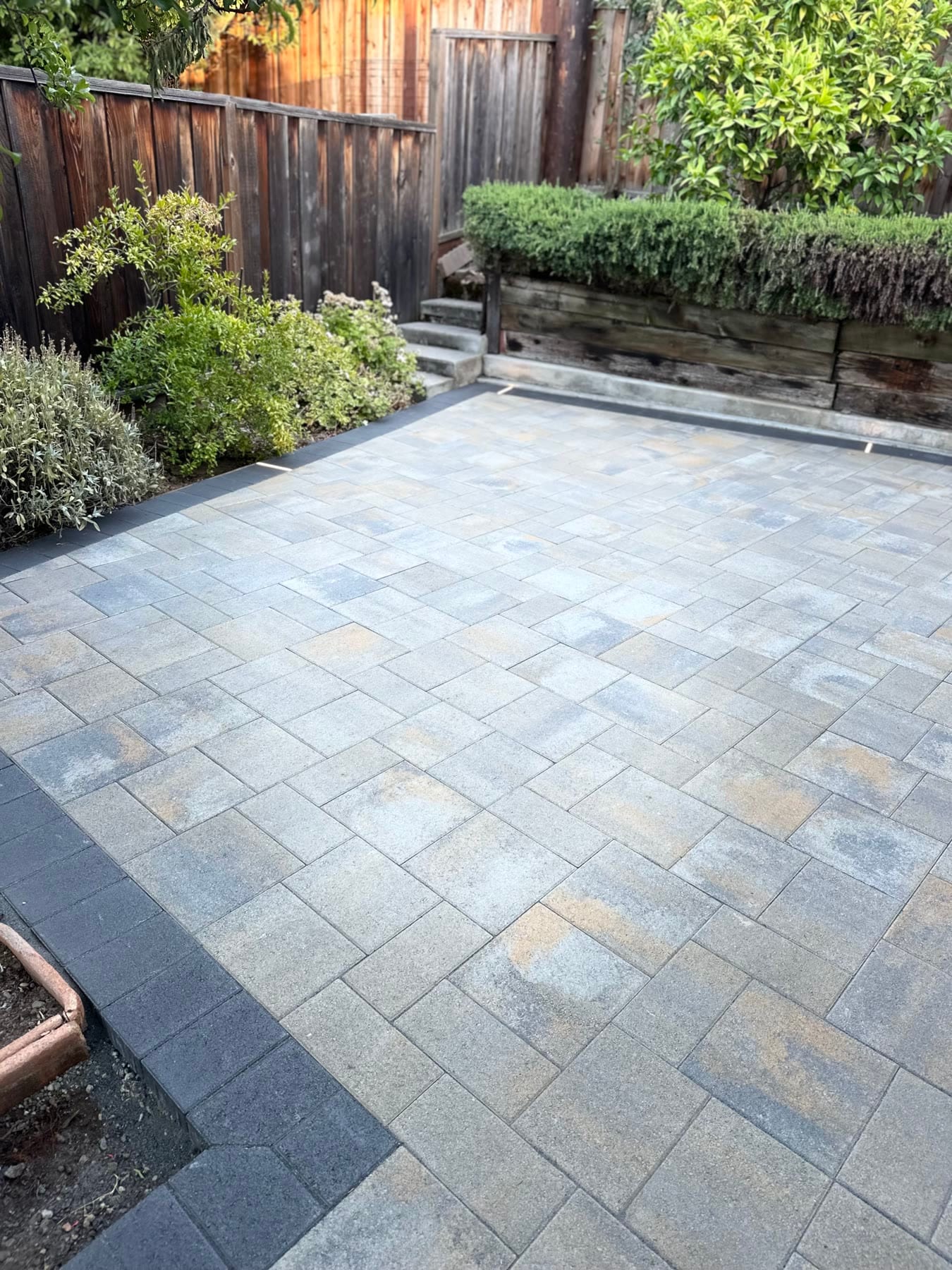
Tell us about your project.
Free, no-obligation estimate. We come measure on-site, walk you through the design options, and follow up in writing.