What Actually Happens During a Paver Install: Eight Days in a Bay Area Backyard
Day by day, from the first cut of sod to the final pass of the plate compactor. What the noise is, when your yard looks worst, and the two days that decide whether the patio is still flat in 2040.
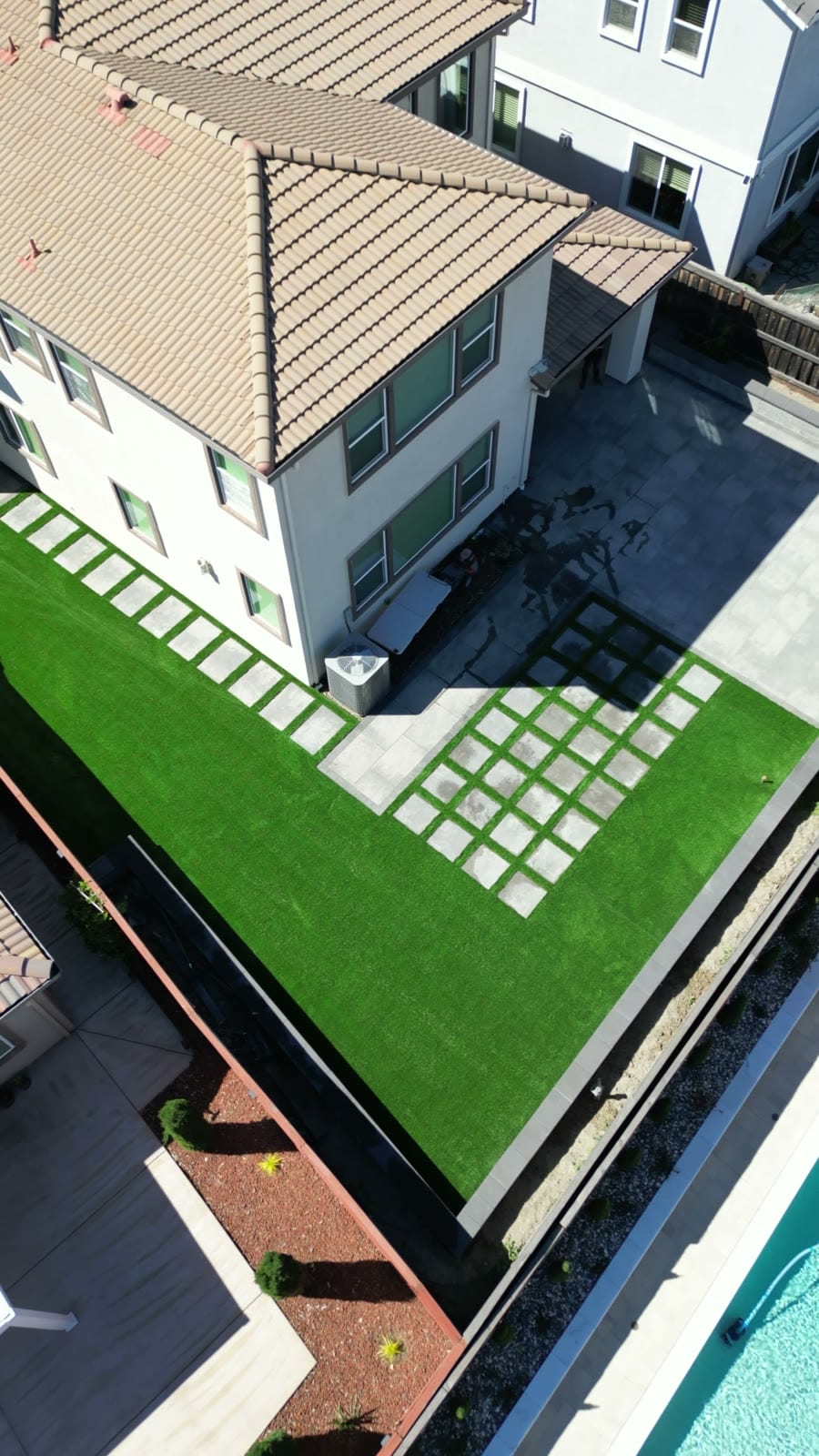
Fairfield, CA from above. Eight days earlier this was sod, clay and a string line.
People picture a paver install as laying pavers. Laying pavers is day six.
Here is what the week actually looks like in a Bay Area backyard, roughly, because access and demo shift everything.
Day 1: layout and demo
We mark the shape with paint and string, confirm it with you standing in the yard rather than on paper, and then everything inside the line comes out. Sod, old concrete, roots, whatever the last owner buried.
This is the day the yard looks like a mistake. It always does.
Day 2: excavation
We dig deeper than people expect. A patio in this area typically comes out around 8 to 10 inches below the finished surface, because 6 inches of that is going back in as compacted base, plus about an inch of bedding sand and the paver thickness on top.
We are also cutting the grade for water at this stage. Every surface pitches away from the house at roughly a quarter inch per foot. You will never feel it. Your foundation will.
Days 3 and 4: the base
This is the job.
Class II aggregate goes in, and it goes in in lifts of three to four inches, each one compacted before the next one lands. Dumping the full depth and running a plate over the top compacts the top two inches and leaves the rest loose, which is how a patio ends up with a birdbath in it two winters later.
On clay we also watch moisture. Base rock compacts properly at a certain dampness, and a crew working in a hurry on a dry August week will get a reading that looks fine and a density that is not.
If you are going to hover and ask questions, hover on these two days. Everything after this is finish work.
Day 5: bedding sand and screed
A thin, even layer of coarse sand goes over the compacted base and gets screeded flat with pipes and a straightedge. About an inch, consistent everywhere.
This layer is not structural and it is not there to fix the grade. If somebody is using bedding sand to level out a bad base, the patio will settle exactly where the sand is thick.
Day 6: laying and cutting
Now the part you have been waiting for. Pavers go down in the chosen pattern, running off a string line, with the field laid first and the edges cut in after.
Cutting is slower than it looks. Curves, borders, the transition at a door threshold, the notch around a downspout. On a saw, wet, one piece at a time. It is most of why a curved patio costs more than a rectangular one.
Day 7: edge restraint and joints
An edge restraint gets spiked in around the whole perimeter. Without it the outer pavers walk outward under load and the whole field loosens from the edges in.
Then polymeric sand goes across the surface, gets swept into every joint, gets vibrated in with the plate compactor over a protective plate, and gets a final sweep. The sand is activated with a careful misting, in stages, so it sets in the joints instead of hazing the paver faces.
Day 8: final compaction, cleanup, walkthrough
Last pass with the compactor to seat everything, blow down the surface, haul out the last of the debris, and then we walk it with you.
Furniture goes on the same day. No curing, no waiting, no taped-off slab for a week.
The two days that matter
If you remember nothing else from this: days 3 and 4.
The pavers on top are the part you will photograph. The compacted base under them is the part that decides whether you are calling someone in 2032 about a low spot near the barbecue.
That is why base depth and compaction method are written on our estimates, and why we would rather lose a bid to a cheaper number than win it by skipping a lift.
Want to see the finished version of jobs like this? The portfolio has real projects from Fairfield, Sunnyvale, Orinda and San Anselmo. For a free on-site design consultation, call 1-888-282-1344.
Frequently asked questions
How long does a paver patio take to install?+
A typical Bay Area backyard patio runs five to eight working days. Excavation and base take up roughly half of that, and that half is the part that decides whether the patio stays flat. Bigger jobs, difficult access, or heavy demo add days.
Can I use my yard while the work is happening?+
Not really, and the middle days are the worst. There is an excavator or a skid steer, open trench, loose base rock and equipment parked where your lawn used to be. We keep a clear path to the house and we clean the site at the end of each day, but plan on the yard being out of service for the week.
What is that heavy thumping noise?+
A plate compactor. It runs during base compaction and again at the very end to lock the pavers into the bedding sand. It is loud, it is repetitive, and it is the single most important machine on the job. We keep it to normal working hours.
How soon can I put furniture on a new paver patio?+
Right away. Unlike a poured slab there is no curing period. Once the joints are sanded and the final compaction is done, the patio is finished and load-ready the same afternoon.
Paver Patios
Outdoor living rooms built to host every season.

Written by João at Royal Outdoor Solutions
Family-owned Bay Area hardscape contractor with 15+ years of hands-on experience installing paver patios, driveways, walkways, pool decks and retaining walls. Licensed, bonded and insured.
1-888-282-1344
Tell us about your project.
Free, no-obligation estimate. We come measure on-site, walk you through the design options, and follow up in writing.