Paver Pool Deck vs. Concrete: What Actually Holds Up Around a Bay Area Pool
Heat underfoot, slip resistance, cracking, and what happens when the pool plumbing needs work. A side-by-side look at paver and concrete pool decks from a crew that builds them across Solano County and the East Bay.
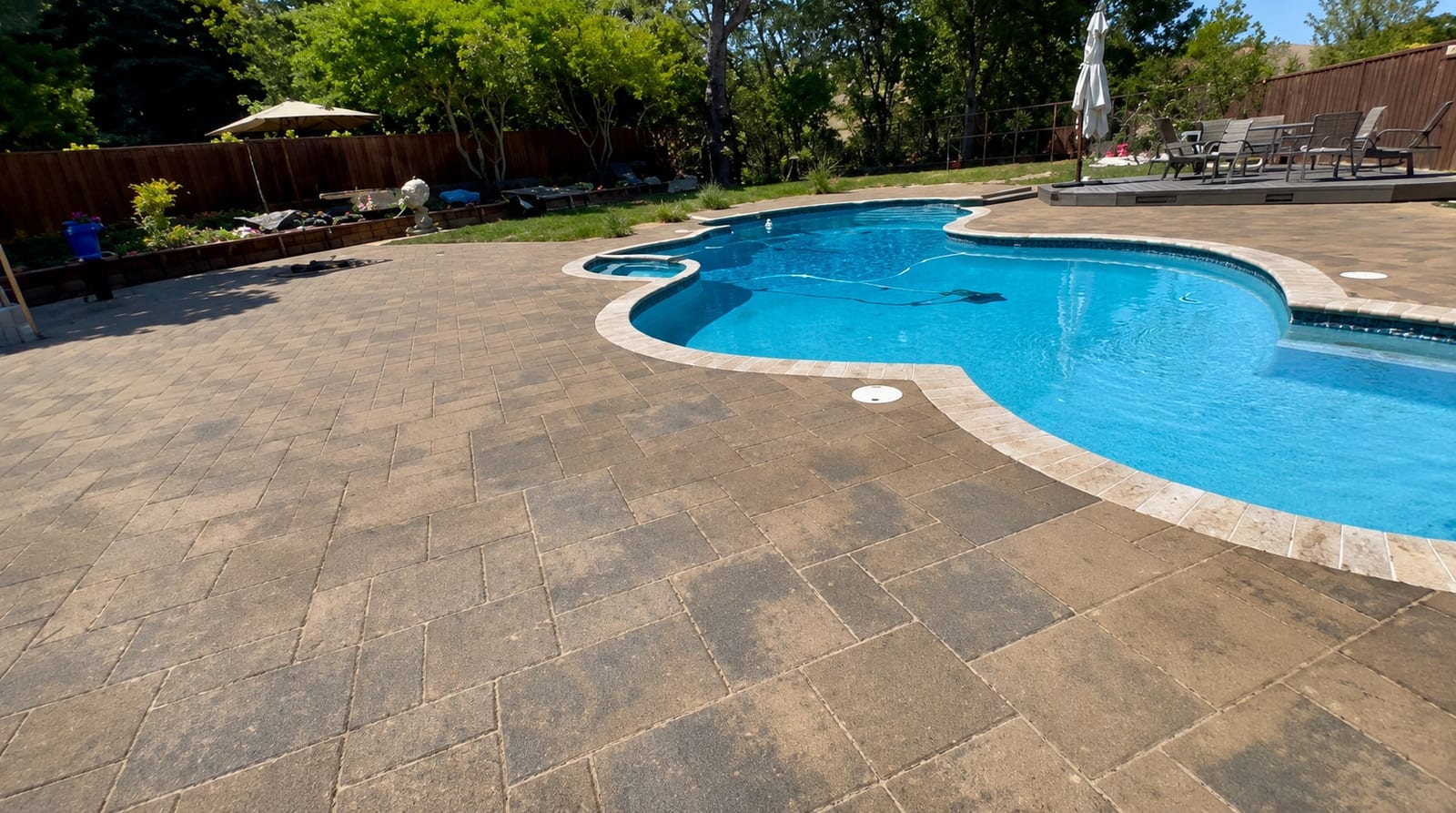
Every pool deck in the Bay Area gets the same treatment: full sun from May to October, bare feet, wet chlorinated water splashing on it all day, and clay soil moving underneath it every winter. Most of the pool decks we are asked to look at were poured concrete, and most of them are cracked, stained, or slick enough to be a real hazard around water.
This is a straight comparison between a paver pool deck and a concrete one, based on what we see when we tear the old ones out and what holds up years later. If you are in Fairfield, Vacaville, Benicia or anywhere in Solano County and the East Bay, this is the conversation we have on almost every pool project.
Heat underfoot
The first thing anyone notices about a pool deck in August is whether they can walk on it. Surface temperature depends far more on color than on material. A dark charcoal paver and a dark stained concrete slab will both burn your feet. A light sand, cream or pale gray paver stays noticeably cooler than a mid-tone broom-finished slab in the same sun.
Pavers give you the color choice. Concrete gives you gray, or a stain that fades and wears off in the traffic lanes. With pavers you can also run a lighter field with a darker border, which keeps the walking surface cool and still gives the deck a finished edge.
Slip resistance when it is wet
This is the one that matters for safety. Pavers have a textured surface and a joint every few inches. Both break up the film of water that makes a surface slick. Broom-finished concrete is acceptable when it is new, but as soon as it is sealed or acid-washed for looks, it turns into a skating rink around the pool. Smooth-troweled or stamped concrete is worse.
We install pool deck pavers with a non-slip finish and, where the owner wants a sealer for color, we use a sealer with a grit additive. You get a deck that looks good and still gives bare feet something to grip.
Cracking and ground movement
Here is where the Bay Area makes the decision for you. Much of Solano County, Contra Costa and the Tri-Valley sits on expansive clay. It swells when the winter rain comes and shrinks over the dry summer. A pool deck is a wide, thin slab sitting on top of that movement, next to a giant hole in the ground full of water. Concrete cracks. It always does, and the control joints only decide where.
An interlocking paver deck is built from individual 8,000 PSI pavers on a compacted gravel base with a bedding layer and an edge restraint. The whole system flexes with the ground instead of fighting it. If a section ever settles, the pavers are lifted, the base is topped up, and the same pavers go back. No visible patch, no crack running across the deck toward the coping.
When the plumbing or the electrical needs work
Every pool has plumbing and conduit under the deck. Skimmer lines, return lines, the light conduit, sometimes the main drain run. On a concrete deck, any leak or any equipment upgrade means a saw cut, a jackhammer, a patch that never matches, and a new crack line a year later.
On a paver deck, we lift the pavers over the line, do the work, compact the base and set the same pavers back. Homeowners who have gone through one pool repair on concrete usually do not need much convincing on this point.
Drainage and the coping
A pool deck has to move splash and rain water away from the pool and away from the house. That is a slope of about a quarter inch per foot, plus a drain where two slopes meet. On a concrete deck the drain is a channel cast into the slab that fills with debris and is impossible to service. On a paver deck we set channel drains or deck drains in the base, and the joints between pavers also let some water through to the base instead of sheeting across the surface.
We also pay attention to the coping. Whether you keep the existing coping or replace it, the paver surface has to meet it cleanly and sit slightly below it, so water never runs back into the pool shell.
Installed cost in the Bay Area (2026)
Concrete is cheaper on the day you write the check. Over the life of the pool, it usually is not.
| Deck type | Installed range per sq ft | What is included |
|---|---|---|
| Broom-finished concrete | $14 – $22 | Demo, forms, rebar, pour, finish |
| Stamped or colored concrete | $20 – $32 | Same, plus stamping, color, sealer |
| Paver pool deck | $30 – $50 | Demo, excavation, compacted base, drainage, pavers, edge restraint, joint sand, cleanup |
| Paver deck with new coping, steps or seat wall | $45 – $70+ | Priced as a project |
For a typical 600 to 900 square foot Bay Area pool deck, that puts a paver rebuild between $18,000 and $45,000 depending on size, access and features. The cheap concrete deck is the one you pay for again in eight to twelve years when it is cracked and stained enough to replace.
What a proper paver pool deck build looks like
- Demolition and haul-away of the existing deck, protecting the coping and the pool shell.
- Excavation to the right depth, with the sub-grade compacted.
- Crushed rock base, installed and compacted in lifts, sloped away from the pool and the house.
- Drainage set in the base where slopes meet and along the house.
- Bedding layer, screeded flat.
- Pavers set in the pattern, cut cleanly around the coping, skimmers and equipment.
- Edge restraint so the deck never spreads.
- Joint sand compacted in, then a slip-resistant sealer if the owner wants one.
The base and the drainage are where a quote gets cut when someone is competing on price. Ask about them before you ask about the pavers.
Questions to ask any pool deck contractor
- How deep is the base and how is it compacted?
- Where does the water go, and where are the drains?
- How will the deck meet the coping?
- Can I choose a light paver color for heat?
- Is the crew licensed, bonded and insured to work around a pool?
- Is the warranty in writing?
The short version
Concrete is the cheaper deck to pour and the more expensive one to own around a Bay Area pool. Pavers stay cooler in a light color, grip better when wet, do not crack with the clay, and open up for repairs. If you are replacing a cracked deck rather than building a new pool, the choice is even easier, because you are already paying for demolition either way.
Royal Outdoor Solutions builds paver pool decks, patios and walkways across Solano County, the East Bay, Contra Costa, Marin, the South Bay and the Tri-Valley. Family-owned, 15+ years of experience, licensed, bonded and insured, manufacturer's warranty in writing. See the pool deck service, look at finished pool decks and patios, or book a free on-site design consultation.

Written by the Royal Outdoor Solutions team
Family-owned Bay Area hardscape contractor with 15+ years of hands-on experience installing paver patios, driveways, walkways, pool decks and retaining walls. Licensed, bonded and insured.
1-888-282-1344More guides
All guides →
Tell us about your project.
Free, no-obligation estimate. We come measure on-site, walk you through the design options, and follow up in writing.