Paver Walkway Cost in San Francisco, CA | 2026 Guide and City Rules
A paver walkway in San Francisco usually runs $30 to $50 per square foot installed, and city jobs tend to sit in the upper half of that range. City lots add costs you will not see in the suburbs: no side-yard access, street parking, sandy or clay soil, and a front-yard rule that caps how much you can pave. Here is what to expect and how to plan it.
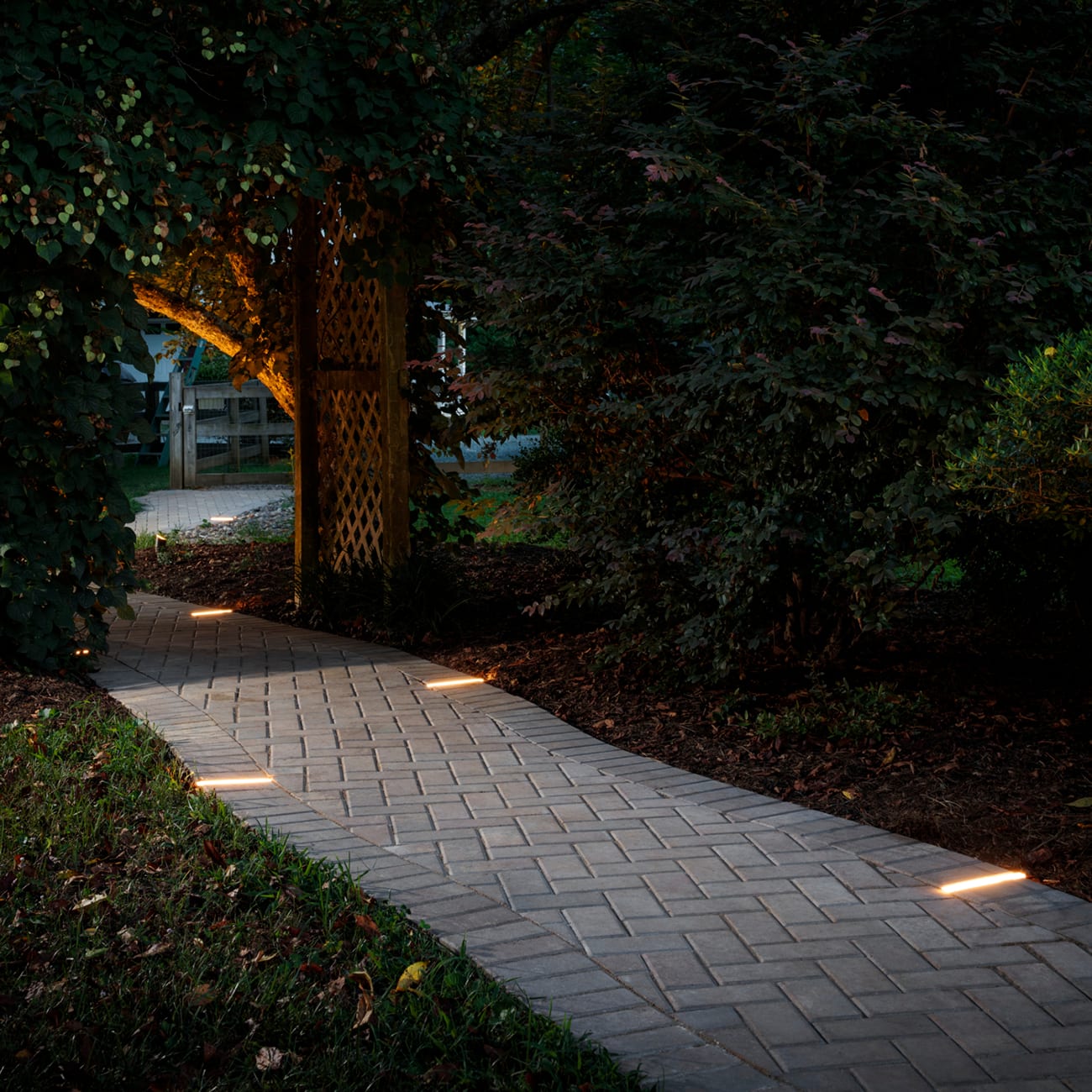
Herringbone paver walkway with lights set into the border. On a narrow San Francisco walk the pattern and the edge do most of the design work.
A paver walkway costs $30 to $50 per square foot installed in 2026, and in San Francisco expect the upper half of that range. The typical city front walk, 3 to 4 feet wide and 20 to 30 feet from the sidewalk to the front steps, lands between $3,000 and $6,000.
In our Sunnyvale price guide the same walkway sits closer to the bottom of the range. The paver costs the same in both cities. What changes is getting the dirt out and the base in, on a lot where the only way to the front yard might be the garage.
What does a paver walkway cost on a San Francisco lot?
Here is roughly where common San Francisco projects land:
| Project | Typical size | Installed price |
|---|---|---|
| Front walk, sidewalk to steps | 3 to 4 ft wide, 20 to 30 ft | $3,000 to $6,000 |
| Front walk plus a landing at the stairs | 100 to 150 sq ft | $4,000 to $7,500 |
| Side passage to the backyard | 3 ft wide, 40 to 60 ft | $5,000 to $9,000 |
| Front yard redo, walk plus sitting pad | 200 to 400 sq ft | $8,000 to $20,000 |
Steps on a sloped lot are priced on top of the walk, one by one, because each is its own small wall. Small jobs also carry a minimum: under about 60 square feet, a crew costs the same to mobilize whether it lays 40 feet or 60.
Walkways are the most expensive hardscape per square foot anywhere, because they are narrow and almost all edge. Every foot of walkway has two feet of border and restraint. A 4-foot walk costs less per foot than a 3-foot one for the same reason.
Why is San Francisco more expensive to build in?
Four things show up on city lots that suburban bids never deal with.
Access. Most San Francisco houses sit shoulder to shoulder with no side yard. A compact loader does not fit, so excavation comes out by hand or in a small power buggy, often through the garage. On a 25-foot walkway that can mean moving 3 to 4 tons of soil and old concrete by wheelbarrow.
The street. Crews park where they can. A dumpster or a pallet of pavers on the street needs a permit from Public Works. None of this is expensive by itself. It adds hours, and hours are what you pay for.
The ground. The Sunset, the Richmond and parts of Parkside sit on old dune sand. Sand drains well, which is good, but it moves when it is not contained, so the base needs a firm edge restraint and sometimes a geotextile layer under the rock. East of Twin Peaks you are more likely to find clay and fill, which swells when wet. Both are fine for pavers. They just get built differently, and a bid should say which one it is built for.
Slope. Noe Valley, Bernal Heights, Glen Park and half of the city have front walks that climb. Steps and landings cost more than flat walkway, and on a steep run the walk needs a small retaining edge so the base does not creep downhill. We wrote about what slope does to a budget in our San Anselmo hillside project.
Can I pave my whole front yard in San Francisco?
Usually not, and this is the rule most homeowners have never heard of.
Under Planning Code Section 132, if you pave or repave more than 200 square feet of the front setback in a residential district (RH, RM or RTO), two requirements kick in:
- At least 20 percent of the required front setback has to stay unpaved and planted.
- At least 50 percent of it has to be permeable, so rain soaks in instead of running into the sewer.
The planted 20 percent counts toward the permeable 50 percent. Permeable interlocking pavers count toward the 50 percent too, but not toward the planted 20. Turf pavers and grass-in-grid systems count only as permeable.
In practice that pushes most front yards toward the same layout: a paver walk from the sidewalk to the door, a planting bed or two, and maybe a small sitting pad in permeable pavers. It is also the layout that looks best on a narrow city lot, so the rule and good design agree more often than you would think.
A straight walkway replacement well under 200 square feet does not trigger it. Anything bigger, check your lot with SF Planning before you sign. Work past your property line, the sidewalk and the planting strip at the curb, belongs to Public Works and needs its own sidewalk permit.
Which pavers hold up in San Francisco weather?
Fog is the local enemy. West of Twin Peaks a north-facing walk can stay damp for weeks, and damp plus shade grows moss and algae on anything smooth.
What works:
- A textured or tumbled face, not a polished or smooth one, on any walk that stays in shade
- A slope of about a quarter inch per foot so water runs off instead of sitting
- Polymeric sand in the joints, which keeps weeds and ants out and sheds water
- Lighter colors on shaded walks, because they show moisture less and read brighter on grey days
- A light cleaning once or twice a year, before and after the rainy season
We install pavers rated up to 8,000 PSI, roughly twice the compressive strength of standard residential concrete. On a walkway nobody needs that for weight. It matters because a dense paver soaks up less water, and a surface that dries faster grows less on it through a San Francisco winter.
If you need the permeable share for the Section 132 rule, a permeable paver with wider joints and an open-graded stone base does the job. It costs more than a standard walk because the base is deeper and the stone is different, so ask for it as a separate line on the bid.
What should a San Francisco walkway bid include?
Three bids for the same walk can be $3,000 apart, and the cheap one is usually missing something under the pavers. Ask each contractor to put these in writing:
- Base depth and how it is compacted. For a walkway, 4 to 6 inches of Class II base, compacted in lifts of a couple of inches, not dumped in one pass. We build every job on our Permalast Layered Install System, which is our name for that process: excavate to firm soil, place and compact the base in layers, then bedding sand, pavers and edge restraint.
- Edge restraint. On sand soil this is what stops the walk from spreading. It should be named in the bid, not assumed.
- Demolition and haul-off. Old concrete, old brick, soil. How it leaves the lot and who pays the dump fees.
- Access plan. Through the garage, over the stairs, hand-carry or buggy. If a bid does not mention it, the contractor has not looked at your lot yet.
- Permits. Who checks the Section 132 numbers and who pulls the sidewalk permit if the work touches the public side.
More on reading bids in our guide on how to choose a paver contractor in the Bay Area. If you are also weighing concrete for the walk, the tradeoffs are the same ones we covered in pavers vs concrete for driveways: concrete is cheaper on day one, and pavers are cheaper the first time something has to be dug up.
How long does a walkway take in San Francisco?
A typical front walk takes three to five working days. One day to demolish and dig, one to build and compact the base, one or two to lay, cut and set the border, and half a day for sand, compaction and cleanup. Steps add a day. A side passage where everything is hand-carried can double the dig time.
If you are in the city and want a number for your own walk, send us a few photos of the front yard and the street in front of it. The street tells us as much about the price as the yard does. We will come out, measure, check the setback math with you and give you a written, line-by-line quote.
Frequently asked questions
How much does a paver walkway cost in San Francisco?+
Paver walkways run $30 to $50 per square foot installed in 2026, and San Francisco jobs usually land in the upper half of that range. A front walk 3 to 4 feet wide and 20 to 30 feet long, which is common on a city lot, usually lands between $3,000 and $6,000. Tearing out old concrete, steps, hand-carrying material through the house or garage, and permeable pavers push the number toward the top.
Why do walkways cost more per square foot in San Francisco than in the suburbs?+
Access and hauling. Most San Francisco lots have no side yard wide enough for a machine, so excavation and base are moved by hand or with a small power buggy. Crews also deal with street parking, bins that need a permit to sit on the street, and steep blocks. The square footage is small, so those fixed costs weigh more on every foot.
Do I need a permit to put pavers in my front yard in San Francisco?+
It depends on how much you pave. Under Planning Code Section 132, paving or repaving more than 200 square feet of the front setback in residential (RH, RM and RTO) districts triggers two rules: at least 20 percent of the setback must stay unpaved and planted, and at least 50 percent must be permeable. Anything past your property line, like the sidewalk strip, is Public Works territory and needs a sidewalk permit. Check your lot with SF Planning before you start.
Do permeable pavers count toward the San Francisco front yard rule?+
Yes, permeable interlocking pavers and similar porous surfaces count toward the 50 percent permeable requirement. They do not count toward the 20 percent that has to stay planted. Turf pavers and other planted hardscape also count only as permeable, not as landscaping.
Will fog and shade make my pavers slippery?+
They can grow moss and algae faster in the western neighborhoods, where the fog sits for weeks. A textured or tumbled paver, a slight slope so water does not sit, joints filled with polymeric sand and a light cleaning once or twice a year keep a walkway safe. Smooth, dark pavers in full shade are the ones that get slick.
Walkways
Pathways that guide the eye and protect the lawn.

Written by the Royal Outdoor Solutions team
Family-owned Bay Area hardscape contractor with 15+ years of hands-on experience installing paver patios, driveways, walkways, pool decks and retaining walls. Licensed, bonded and insured.
1-888-282-1344
Tell us about your project.
Free, no-obligation estimate. We come measure on-site, walk you through the design options, and follow up in writing.